
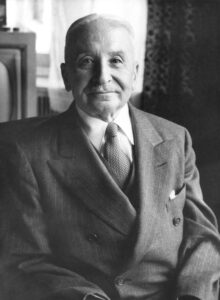
Among twentieth century economists one of the most original and controversial was the Austrian Economist, Ludwig von Mises. For more than six decades beginning before the First World War, Mises was a leading voices for individual freedom and the capitalist system. During a time when socialist and interventionist ideas and policies seemed to be the almost inescapable wave of the future, he consistently and uncompromisingly defended human liberty, private property, the free market, and limited government.
Ludwig von Mises was an original scholar, an insightful policy analyst, and an influential teacher in both Europe and the United States. Without exaggeration, his books, essays, lectures, and personal impact on others were crucial in stemming the intellectual trends toward various forms of collectivism during the last 100 years. Mises’s most famous protégé, the Austrian economist and Nobel laureate F. A. Hayek, once said, “There is no single man to whom I owe more intellectually. . . . He certainly had more influence on my outlook of economics than any other man.”
Mises was born in Lemberg (now Lvov) in the old Austro-Hungarian Empire on September 29, 1881. He attended the University of Vienna and earned a doctoral degree in jurisprudence in 1906, with an emphasis on economics. He made his living, however, not in academia but in the world of public policy, in the role of economic analyst for the Vienna Chamber of Commerce, Crafts, and Industry, a position he held from 1909 until 1934.
In the Austria between the two world wars he was a leading figure in bringing the Great Austrian Inflation to a halt and assisted in reorganizing the Austrian National Bank on a non-inflationary, gold-backed basis. He was an influential voice in preventing the Austrian socialists from nationalizing commerce and industry and was in charge of a department of the League of Nations’ Reparations Commission in Austria.
During these years Mises also founded the Austrian Institute for Business Cycle Research, taught a highly acclaimed seminar each term at the University of Vienna, was the Austrian representative of the European Free Trade Association, and led a world-renowned private seminar for Austrian and visiting scholars at his office at the Chamber of Commerce.
But his international recognition during these years and the remainder of his life was the result of his profoundly important contributions to economics and social philosophy. Even before World War I he developed what became known as the Austrian theory of money and the business cycle in The Theory of Money and Credit (1912); he showed that inflations and depressions had their origin in government mismanagement of the monetary and banking systems. Attempts by central banks to artificially keep interest rates below market levels through monetary expansion resulted in unsustainable imbalances between savings and investment that eventually required an economy-wide correction in the form of recessions and sometimes depressions.
But Mises’s most famous contribution in the period immediately following World War I was his demonstration, in his 1920 article “Economic Calculation in the Socialist Commonwealth” and in his treatise Socialism: An Economic and Sociological Analysis (1922), that socialist central planning was inherently unworkable for any rational use and allocation of the goods and resources in society. The abolition of private property, the elimination of monetary transactions, and the end of market-based competition meant the loss of the price system. But market-generated prices were the essential social tools by which all the goods and services, resources, and capital could be reduced to a relatively simple and useable common denominator for purposes of economic calculation by consumers, producers, and resources owners. Hence, socialism must result in, what Mises called in the title of a later book, Planned Chaos (1947).
In his 1927 work, Liberalism, Mises defended the institutions and workings of the free-market economy by demonstrating the importance of individual freedom, private property, and rule of law if man is to live in a world of domestic and international peace, and enjoy material prosperity and cultural improvement.
He warned of the inherent contradictions and inevitable distortions resulting from various types of government regulation in Critique of Interventionism (1929). The fundamental problem with various government pricing and production controls is that it prevents the necessary adjusts to changing market circumstances, without which the actions of multitudes of consumers and producers cannot be continuously and successfully coordinated. And he defended the logic and essential value of economic theory for sound thinking about economic policy in Epistemological Problems of Economics (1933).
In 1934 Mises accepted an academic position at the Graduate Institute for International Studies in Geneva, Switzerland. He held this position until the summer of 1940 when he moved to the United States, where he remained the rest of his life until his death in October 1973. In America he was a visiting professor of economics at New York University from 1945 to 1969, when he finally retired from teaching at the age of 89.
It was while he was in Geneva in the 1930s that he wrote the German-language edition of what has become his more famous book, Human Action, A Treatise on Economics (1949), in which he synthesized all of his earlier works into a comprehensive vision and logic of freedom and the capitalist economy. In his review of the German-language edition of the book, F. A. Hayek said it “ranges from the most general philosophical problems raised by all scientific study of human action to the major problems of economic policy of our own time.”
Here the reader finds a detailed and well-grounded conception of man, human nature, and society. Mises formulates a theory of social cooperation arising from the benefits from division of labor. He explains the institutional prerequisites for freedom and prosperity, and the workings of the market process, competition, the price system, and the role of the creative entrepreneur. He also restates in a refined exposition his criticisms of socialism, interventionism, and government monetary and fiscal policies.
Mises elaborated further on many of these themes in a number of other books, including Planning for Freedom (1952), Theory and History (1957), and The Ultimate Foundation of Economic Science (1962).
The guiding methodological idea through all of Mises’s writings is that man is the thinking, intentional, and creative actor. He cannot be studied simply by applying many of the methods of the natural sciences. He possesses a special element – consciousness – that is missing from fields of physics and chemistry. The social sciences, therefore, cannot escape from the necessity of resorting to an element of analysis usually shunned by the physical sciences: introspection.
Man has the ability to “look inwards” to try to understand the logical and rational processes of both his thinking and his acting. Hence, the core concepts and “laws” of economics are derived through man using his “mind’s eye” to observe and trace out the logic of action and choice in his own thought processes as the starting point and building blocks for a theory of the market process. The role of such a theory is to provide an interpretive framework that enables an understanding of both historical and contemporary events, as well as supplying a guide for analyzing the likely outcomes from various economic policies and actions.
All of Mises’s works were written at a time when freedom and the free society appeared destined for defeat, reduced to a soon-to-be-forgotten chapter of human history. Especially during the immediate decades after Mises moved to the United States during the Second World War, socialism, interventionism, and Keynesian economics all seemed to be heading for triumph throughout the globe. Voices like Mises’s were increasingly marginalized and often ignored.
But with the economic failure and political collapse of socialism and the “rediscovery” of the power of markets to generate wealth and increase freedom during the last 20 years, Mises’s insightful originality on the nature and workings of the capitalist system is once again being appreciated.
The financial shocks that are currently reverberating around the world may also awaken interest again in his analysis of how monetary mismanagement by governments sets the stage for imbalances and distortions in banking, investment and consumer markets that inevitably result in periods of recession and depression. And that the only long-run cure for such problems is to see to it that central banks are not allowed to set the process in motion, to begin with, through monetary expansion and interest rate manipulations.
Mises’s defense of the capitalist system was grounded philosophically in a version of utilitarianism, the theory that actions and institutions may be judged by the results that they produce. A question that remains in any analysis of his contributions as a whole is whether a free society can be successfully defended in the long run if such a “consequentialist” approach is not complemented by a wider moral justification of individual rights and the private property order.
Entry By: Richard Ebeling
Ludwig von Mises titles available through Liberty Fund.
Online Library of Liberty resources on Ludwig von Mises.
Books by Ludwig von Mises at Amazon.
Brief video introduction to Ludwig von Mises from the American Institute for Economic Research.
Video introduction to Ludwig von Mises by Eamonn Butler at the Institute for Economic Affairs.