
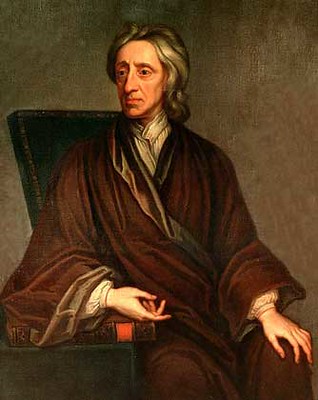
John Locke (1632-1704) was an Enlightenment thinker, philosopher, and physician whose work inspired generations to come including the Founding Fathers of the United States, particularly in regards to ideas such as limited government, social contracts, and an individual’s free will as part of natural law.
Locke was born and grew up just outside Bristol, England. He attended Oxford University for both his undergraduate and Master’s degrees before becoming a personal physician to a nobleman named Lord Ashley in 1667. While caring for Ashley, who was a founder of the Whig movement, Locke developed many of his own political ideas.
Locke took many of the ideas expressed in Thomas Hobbes’ Leviathan (1651) and developed them into a more realistic depiction of modern society; one filled with less absolutes and more social ambiguity in which men are more than just brutal savages in the state of nature. Instead, Locke views them as individuals that for the most part, mean well as they use their reason and labor to seek out their own self-interest. They are born as equals and engage in social contracts in which they give up their right to wander in exchange for membership in a civilized society that provides community and protection.
Locke also introduced his own theory of rights where humans are ordained with rights as a rule of nature rather than being given rights by a governing body or social institution. He believed these rights needed to be protected by incorporating a separation of powers into any government created in order to prevent overreach and openly encouraged revolution if the government did overstep their bounds.
His most influential work, Two Treatises of Government (1689), echoes many of these ideas, further examining the role of government, property, and the understanding of self.
Almost 100 years later, we see many of these same liberal ideals come to life in the founding pillars of the United States, found in documents like the Declaration of Independence, the Constitution, and the Federalist Papers as figures like Alexander Hamilton, Thomas Jefferson, and James Maddison express the importance of liberty and a limited government.
Without Locke’s ideas on liberalism and individual rights, much of the groundwork for the values we hold dearly as Americans would not have existed in 1776.
Sources:
Wikipedia entry
America’s Survival Guide
John Locke Foundation