
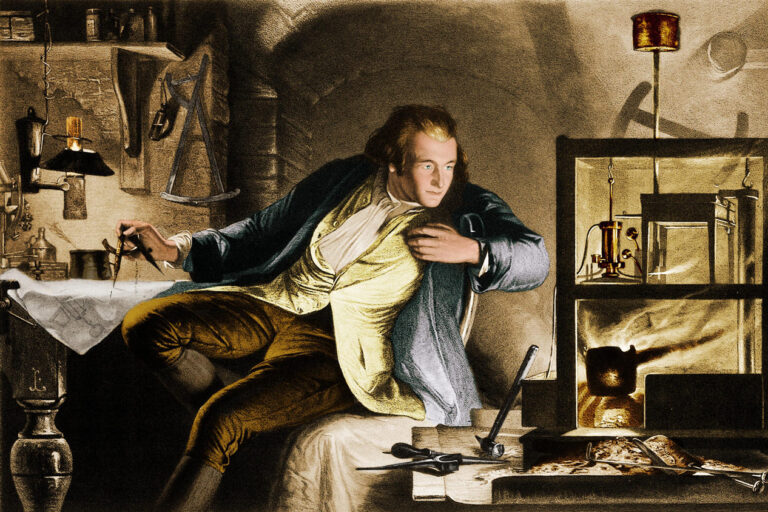
As the first in our series on the heroes of capitalism, today we feature the pioneering Scottish inventor, engineer, and chemist James Watt (1736–1819). In a significant way, the earliest phases of the Industrial Revolution would not have been possible without Watt’s invention of the modern steam engine and his improvements on previous designs. The application of steam power to fields as diverse as transportation, metal manufacturing, textiles, and more led to a great economic lift-off. Productivity and output rose dramatically in the following years and living standards rose with them.
Watt began his career as a home-schooled tool and instrument maker. At the University of Glasgow, where he had set up a shop when the local guild rejected his membership, Watt discovered a Newcomen Engine, a basic forerunner of his steam engine. After years of experimentation and tinkering, Watt perfected his engine and then spent massive sums securing a patent before teaming up with Matthew Boulton to manufacture them.

Watt had helped to unleash new forces on the world, revolutionizing the weaving, milling, grinding, and sawing industries. Between 1794 and 1824, Boulton & Watt made over 1,000 engines with a capacity of over 26,000 total horsepower. Eventually, the steam engine transformed not only the manufacturing industries, but it also sparked the Transportation Revolution with the advent first of steamboats and then railroads. A whole new approach to work spread across the globe as men suddenly could harness the power and energy of steam instead of relying on their own muscles—in effect, Watt helped unleash brain power to conquer muscle power for good.
A further and often too-little noticed aspect of the work of James Watt was the role of precision and how it helped improve technology beyond the immediate reach of steam power. One of the ever-evolving aspects of technology is the degree to which scientists, took-makers, engineers, and others can reach higher and higher levels of precision, which creates a platform for more and more intricate and powerful inventions.
Culturally, James Watt also helped advance the cause of a free society through his participation in the Lunar Society of Birmingham. This informal group of educated Englishmen who gathered to discuss ideas, inventions, and the application of scientific knowledge to the improvement of the human condition. This learned society, though informal, inspired many members over the years to push forward in their pursuits. It represented the best of the Enlightenment tradition of using reason to improve the world.